News

News, Articles and Publications about and by M&C Consulting

2013-03-04-Huffington-DOS-Games

How Games Shape Our World

By | News | No Comments

The text below is an excerpt from the original article by Giovanna Mingarelli, published March 4, 2013 on The Huffington Post.

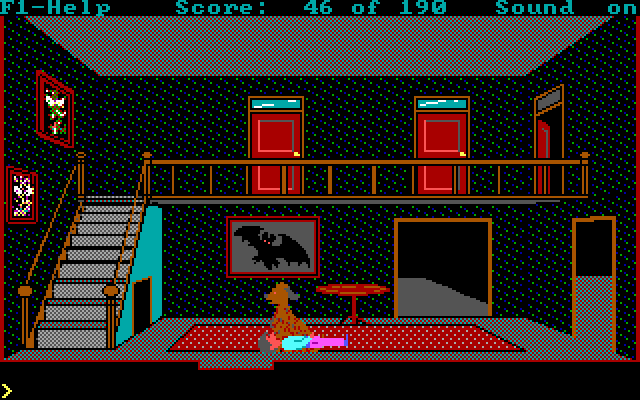
Do you remember playing DOS games like Pong or Hangman? How about the original Wolfenstein 3D on floppy disk?

I do.

My father, a long-time mathematician, started bringing home computers in the late 1980s. I would have been three or four years old and I had no idea at the time the effect that the 1987 IBM PC XT sitting in my family living room would later have on my life. What was my first use of one of the 21st century’s most revolutionary inventions?

Playing games, of course.

I started off with simple stuff like Jump Man: a game created by the now defunct game developer company, Epyx Inc. The point of the game was to diffuse bombs by touching them, where you’d get points for each one you diffused. It was mindless, easy… and kind of fun. Looking back, this was probably my first exposure to operating in a game built around what the current gaming industry refers to as “compulsion loops” — this is a construct which refers to the process of structuring people’s behavior so as to cyclically expect rewards for effort. I.e. run, diffuse bomb, climb latter, get reward, repeat. This construct underpins the architecture of many a game to this day — it’s what keeps the player coming back for more.

According to the Director of Game Research and Development at the Institute for the Future, Jane McGonigal, there are now over three billion hours per week of ongoing gaming around the world — with numbers expected to triple in the next three years. What’s more, 97 percent of youth in the United States now play computer and video games, with most gamers expecting to continue playing games for the rest of their lives.

With billions of hours spent playing them, and built-in patterns designed to keep people hooked, will games have a positive or negative influence on the world? I think it all depends on what kinds of games we choose to play.

Read the full article on Huffington Post

Kony, Government and Crowdsourcing

By | News | No Comments

The text below is an excerpt from the original article by Giovanna Mingarelli, published March 28, 2012 on World Economic Forum Blog.

People around the world have been empowered by social media to take action on the issues they care about

This was made clear by the Arab Spring last year, the ongoing Occupy movement and, most recently, the Kony 2012 campaign. At the heart of the campaign is a 30 minute film created by Invisible Children, Inc., aimed at making indicted Ugandan war criminal, Joseph Kony, famous in order to have to him arrested for the horrific enslavement, abuse and killing of children in Africa over the course of several decades.

These bottom-up social movements have all challenged traditional top-down government structures in their own right. In fact, some might argue the traditional top-down leadership model, once so fitting for governments around the world, has been flipped on its head.

Reflecting on this global trend, the World Economic Forum’s report, Outlook on the Global Agenda 2012, explores the need for governance frameworks to include both informal structures of power and influence, along with traditional formal structures of government, moving forward.

This observation has been driven home by Invisible Children’s director, Jason Russell, who has shown that crowdsourced action through informal social networks can drive meaningful and transformative movements across geographic and political boundaries, given the right cause.

The Kony 2012 video is now the most successful viral video of all time with more than 100 million views – an impressive feat for a 30 minute piece. It has placed widespread and protracted public pressure on governments and institutions, including the United States and the African Union, to respond to their plight. And it has worked. Action is now being taken, by both governing bodies, to capture the fugitive warlord because of this movement.

Read the full article on World Economic Forum


2012-02-20-Hill-Times-Crowdsource

It’s Time to Crowdsource Through Open Innovation

By | News | No Comments

The text below is an excerpt from the original article by Giovanna Mingarelli, published February 20th, 2012 on The Hill Times.

The main idea behind the open innovation business model is that in a world of easily-accessible and widely-distributed knowledge, many companies can no longer afford to rely exclusively on their own research. Instead, they should be encouraged to buy or license inventions or technology from other companies.

Read the full article on Hill Times

admin-ajax.php-4

New Young Leaders Emerge from Davos

By | News | No Comments

The text below is an excerpt from the original article by Giovanna Mingarelli, published February 1, 2012 on The Globe and Mail.

A powerful new force of self-empowered change was introduced at this year’s World Economic Forum in Davos, Switzerland: the Global Shapers Community.

It’s composed of more than 600 young entrepreneurs from around the world, 70 of whom were invited to attend the conference. I was fortunate to be one of three Canadians on the list.

Global Shapers are between the ages of 20 and 30 – the millennial generation – and they have the passion, dynamism and entrepreneurial spirit to shape the future. More than 50 per cent of the world’s population is under the age of 27, so there’s no better group to voice how best to improve the state of the planet.

The theme for this year’s conference was The Great Transformation: Shaping New Models. Global Shapers were invited to participate in every pillar, ranging from new models of leadership to society and technology. I was chosen because of my background as an entrepreneur who has been using new technology – crowdsourcing – to take action on meaningful issues.

Throughout the week of Jan. 25, I helped lead several workshops and roundtables, ranging from how consumers become innovators, to climate change. In both cases, the trend was clear: crowdsourcing has become a force to be reckoned with.

The concept dates back to ancient Rome, where the emperor of the day would elicit a response from a crowd in an open forum by asking for calls in favour of or against an issue.

Read the full article on Globe and Mail

writing-923882_1920

Harvard Business School Case Study, “IfWeRanTheWorld”

By | News | No Comments

Giovanna Mingarelli interviewed for her use of action branding in the Harvard Business School Case Study, “If We Ran The World” on March 2011.

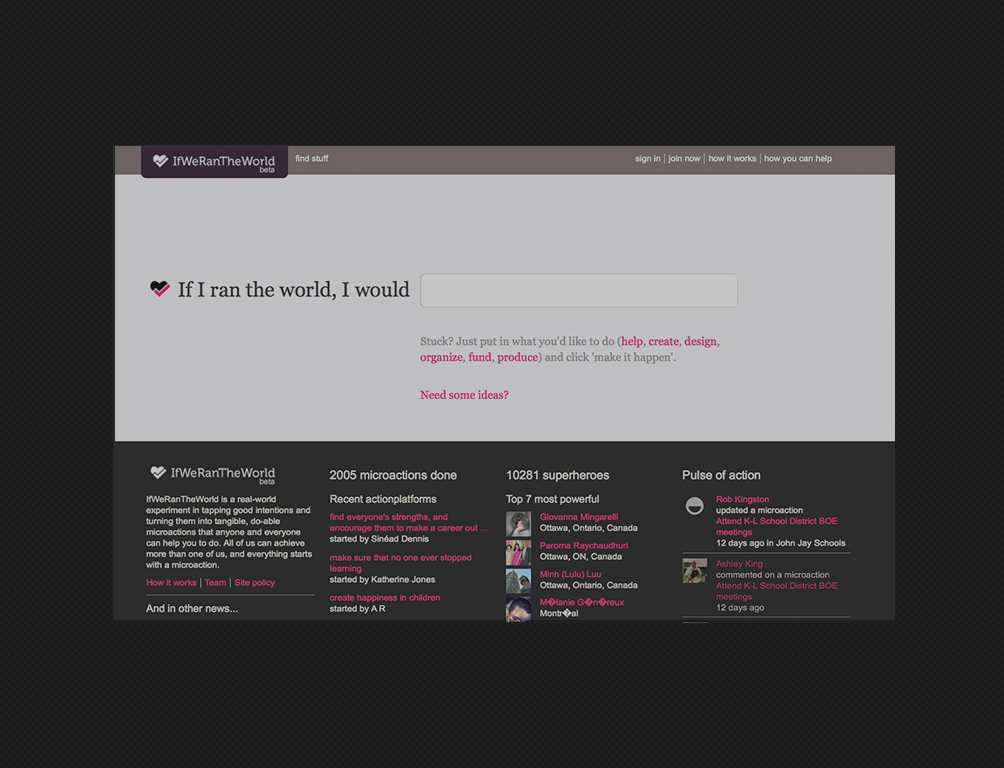
Cindy Gallop launched IfWeRanTheWorld (IWRTW) in February 2010, as what the tech world called minimum viable product, in order to real-world test Gallop’s “business of the future” concept while development was ongoing. IWRTW was conceived to bring together human good intentions with corporate good intentions, to activate both into shared action, against shared goals, to deliver shared and mutually accountable results. She wanted to make “doing good as sexy as hell” for both individuals and businesses, to make it quicker, easier, and simpler to turn intention into action, one “microaction” at a time. In January 2011, Gallop’s key challenge was how to amplify the IWRTW experience in a way that would make it a more valuable-and immediately understandable-business proposition to a brand. The idea behind the venture was only as good as its business model and its execution.

Get If We Ran The World on Harvard Business Review

ifweran_screen2

If She Ran The World She Would…

By | News | No Comments

The text below is an excerpt from the original article by Jon Pincus about Giovanna Mingarelli, published September 11, 2010 on Tales from the Net.

IfWeRanTheWorld CEO Cindy Gallop describes it as “a radically simple web platform designed to turn good intentions into action, one microaction at a time”.  Giovanna’s intention here is straightforward: write a short story. As anybody who’s ever tried to write can tell you, though, that’s easier said than done. Using IWRTW, Giovanna’s defined an ‘action platform’ with the steps to accomplish her goal.

Right now Giovanna’s got 10 microactions ‘in play’ and 36 done. “If We Ran The World allows me to express my intentions in a meaningful and quantifiable way”, Giovanna told me. “I love this platform.”

IWRTW is very social in terms of being designed for people working together (you can target microactions as invitations to act and pick up somebody else’s microactions) so Giovanna’s action platform also invites others to help her if they’re interested. The site’s business model is to work with businesses that want to put together an action platform designed to do good and make money simultaneously, and is still in beta. So far the reviews are positive. Bruce Mau Design’s blog summed it up: “Beautiful design + social engagement + fun to use = awesome!”

Giovanna and I met in a very social network-y way. Tara Hunt (aka @missrogue) tweeted a link to my blog post Guys talking to guys who talk about guys. Cindy saw it, left a comment, and we connected via Twitter and Facebook and Skype. I was immediately struck by IWRTW’s colors and inviting user experience, so different from everything I see out there.

Cindy calls it “emotional software” and the first thing I thought of was work that Karen Fries and Tim Skelly did in the 1990s on Seductive interfaces.  When I asked how people were using the site she knew just who I should talk to.

Read the full article on Tales from the Net

2010-07-09-Equal-Voice-Norway

What Equal Voice learned from the Ambassador of Norway this summer: balance remains critical for women and men in politics

By | News | No Comments

The text below is an excerpt from the original article by Giovanna Mingarelli, published August 9, 2010 on the Equal Voice Blog.

In late July, Nancy Peckford, the Executive Director of Equal Voice, and myself had the privilege of meeting with the Ambassador of Norway, Eikeland Else Berit, and Norwegian intern, Jenny Eline Linge, at the Norwegian Embassy in Ottawa.The meeting was prompted by Ms. Else Berit, who had expressed a keen interest in learning more about Equal Voice and the status of women in Canadian politics.

According to  recent statistics from the Inter-Parliamentary Union, Canada sits at 50th place internationally with respect to the number of women in elected office, where 22 per cent of Canada’s Members of Parliament are women.  According to the United Nations, in order for women to have a sustained and meaningful impact within a country’s legislative assembly, a “critical mass” of least 30 per cent women is necessary.  Despite relative improvements in the last few years, Canada’s numbers have been consistently stagnant since the early 1990s and could definitely use a boost in the upcoming election cycle.

In contrast, Norway is one of several Scandinavian countries with a star record of balanced representation for women and men in elected office at all levels.  Since the early 1980s, the country has undertaken a number of reforms.  These have included the implementation of quotas within some parties, in which it is stipulated that a minimum of “40 per cent women and men” must be elected to the country’s federal legislature.   Norway sits in 8th place internationally with respect to the number of women represented in elected office, where 39.6 per cent of their Members of Parliament are women (since their October 2009 election).

During our meeting, the Ambassador stressed Norway’s experience and relative success with respect to integrating women within their political process.  She noted that the country’s success is partly owing to the fact that women’s participation has been mainstreamed by political parties and the Norwegian electorate alike, where many Norwegians now believe that “democracy,” in its truest form, means “balanced representation for women and men.”

Read the full article on Equal Voice Blog

student-849825_1920 copy

Why Anyone Can Run: Equal Voice looks at Findings from Samara’s Report “The Accidental Citizen”

By | News | No Comments

The text below is an excerpt from the original article by Giovanna Mingarelli, published June 27, 2010 on the Equal Voice Blog.

Samara, a Canadian based charitable organization that studies citizen engagement within Canadian democracy, recently released a report entitled: The Accidental Citizen.  Authored by Samara co-founders, Michael MacMillan and Alison Loat, the report analyzes exit interviews that were conducted with 65 Members of Parliament (MPs) who served in Canada’s 38th and 39th Parliaments (2004-2008).  It presents fascinating findings regarding how MPs chose a life in politics and their reflections surrounding their decisions to run.

Contrary to popular belief, Samara found that the path to politics was far from calculated – it was, more often than not, accidental.  The majority of MPs interviewed weren’t lawyers or millionaires; nor had they spent years in the political arena greasing their political machines before making the decision to run.  On average, the MPs were “normal”, often middle-class, recognized community leaders with educational and professional backgrounds that varied considerably.  Some were recruited to run with a political “ask” from party representatives, whereas  others were encouraged to run by family members and close friends.  They were priests, nurses, small business managers, and Grand Chiefs, to name a few.

What’s more, despite the flurry of differences as to how they got to the gate, what MPs found challenging was the chaotic and often blurry nomination process, or what the authors refer to as “The Black Box.”  In Canada, the nomination process is decided by each party and is often unwieldy and unruly.  Candidates often cited this time as the worst part of running for elected office.  However, Samara noted several benefits to the chaotic nomination process, which include: providing candidates with a platform to debate issues, exploring the finer details of community issues and policy, and providing “good practice for the general election.”

So, what does this mean in the context of Equal Voice and electing more women in Canada?  Anyone can run for office.

Read the full article on Equal Voice Blog